


TL;DR: The hottest debate in AI infrastructure has it all wrong. MCP and Agent Skills aren't competitors—they solve fundamentally different problems. Learn the 5 critical distinctions that separate teams building truly capable autonomous agents from those burning budget on mismatched tools.
🎙️ Podcast: The MCP and Agent Skills Showdown
📺 Video: AI Agents - MCP vs Skills
📑 Slides: The Agentic Blueprint
📝 Deep Dive: MCP vs. Agent Skills: Navigating the Future of AI Workflows
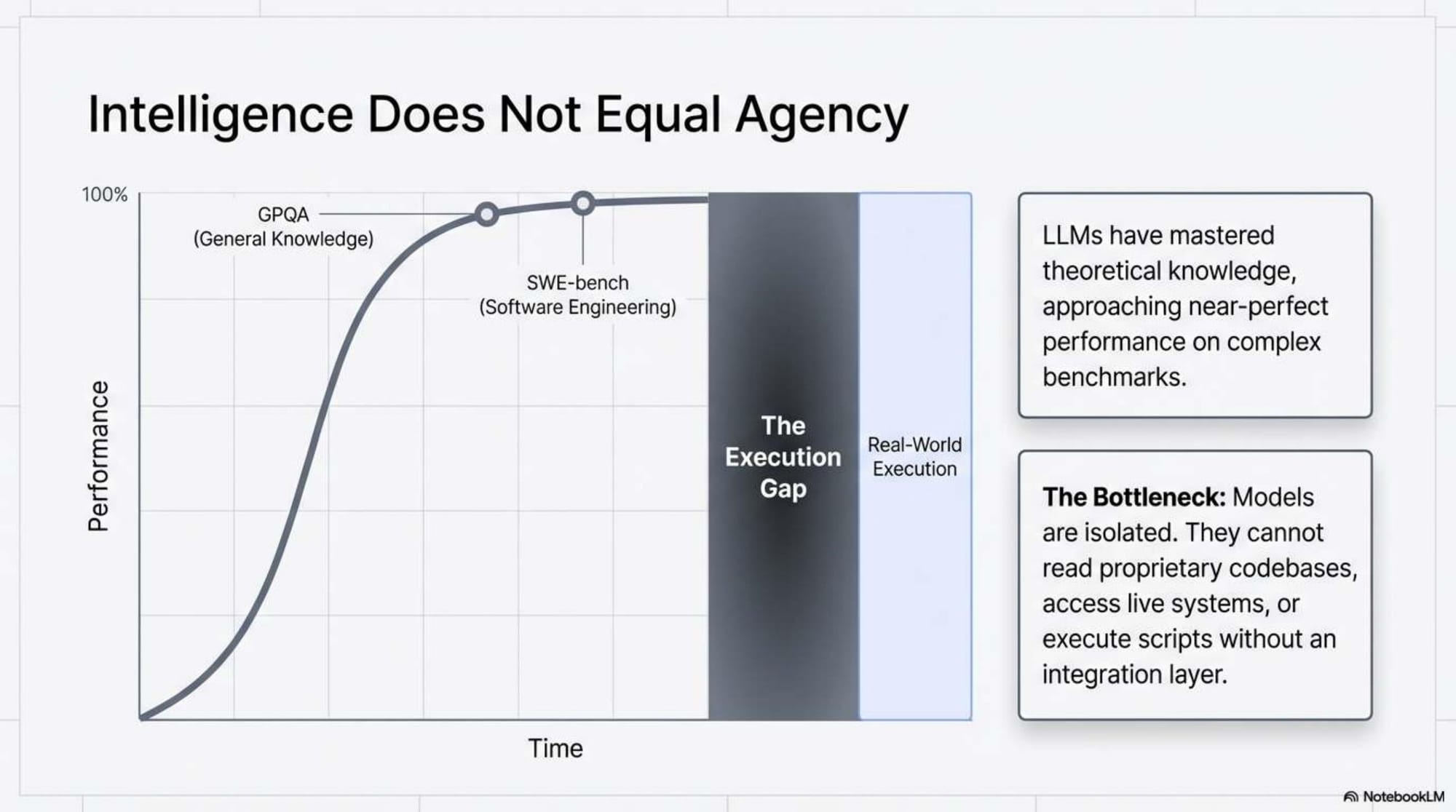
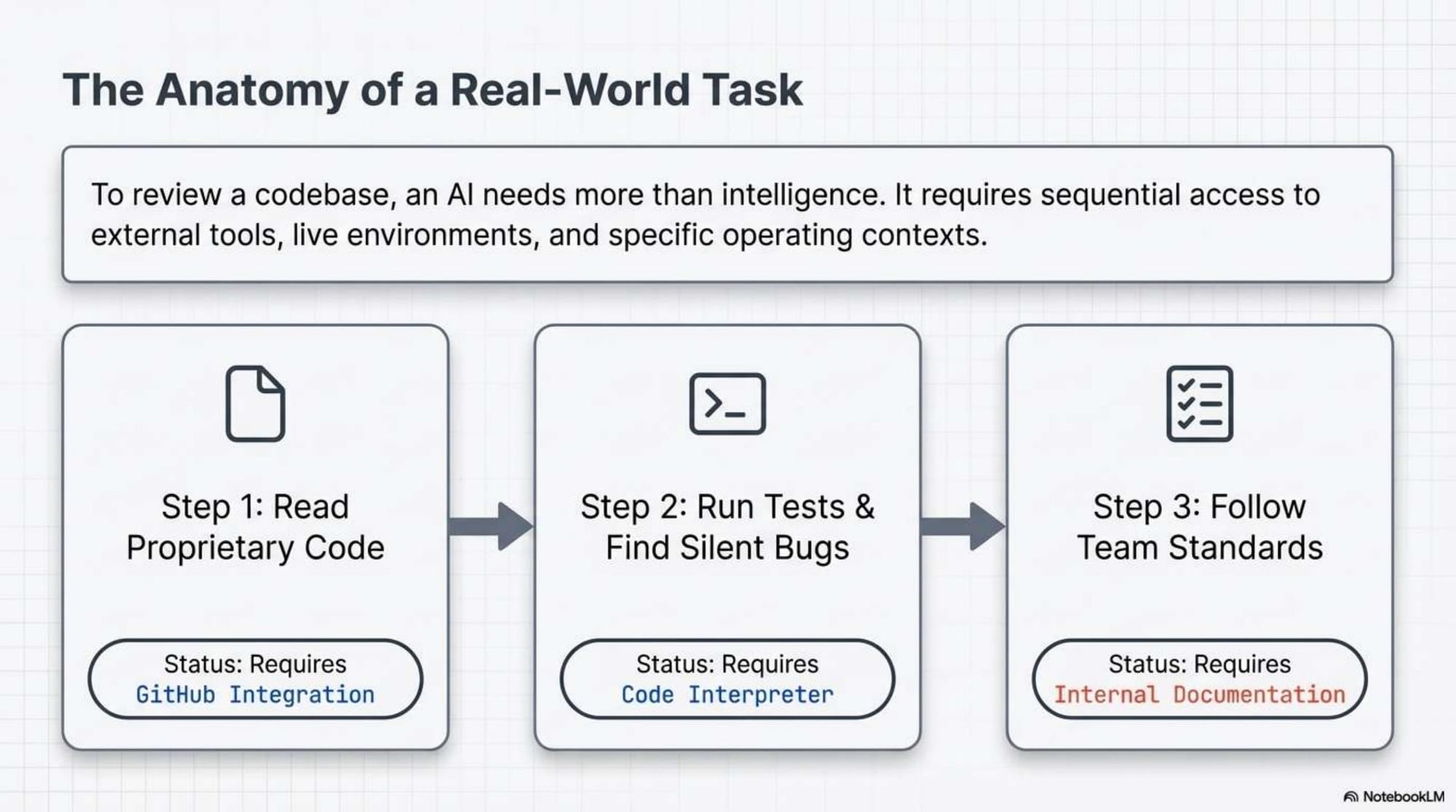
AI models are rapidly evolving, achieving near-perfect scores on complex benchmarks and mastering real-world coding problems. However, a fundamental bottleneck remains: an AI model is only as good as the context and tools it is given. Without access to your company's specific codebase, wikis, or support tickets, even the smartest LLM is limited to what it read on the public internet.
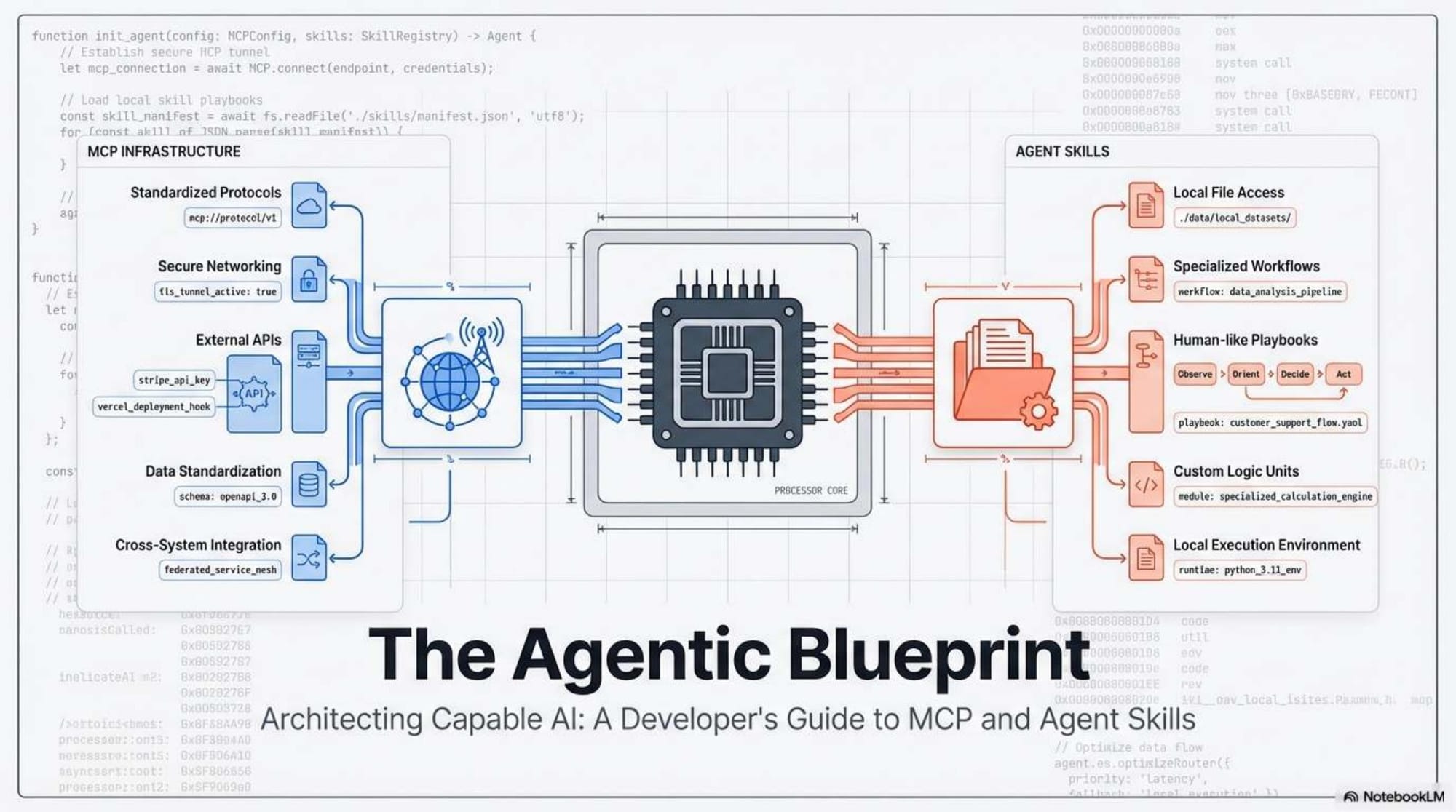
To bridge this gap and allow AI agents to take meaningful action in the real world, developers have turned to two powerful paradigms: the Model Context Protocol (MCP) and Agent Skills. With the recent rise of skills, some have wondered if they spell the end for MCP.
In this post, we'll explore the introduction of both technologies, break down five key insights into how they differ, and explain why you'll likely need both in your AI toolkit.
1. Different Core Purposes: Tool Access vs. Specialized Instructions
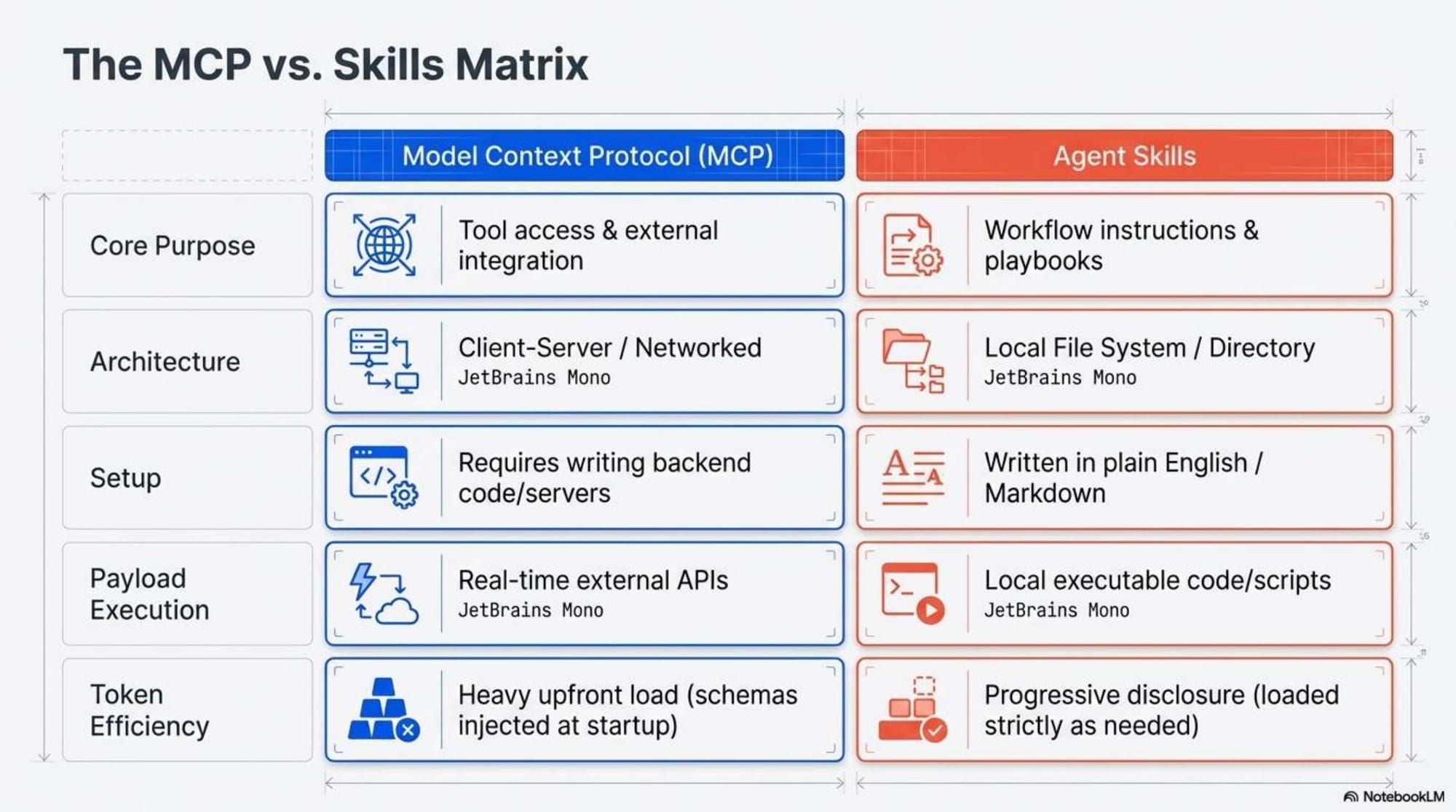
The easiest way to differentiate the two is by their primary function. MCP is designed to give agents access to external tools, while Skills are designed to give agents instructions.
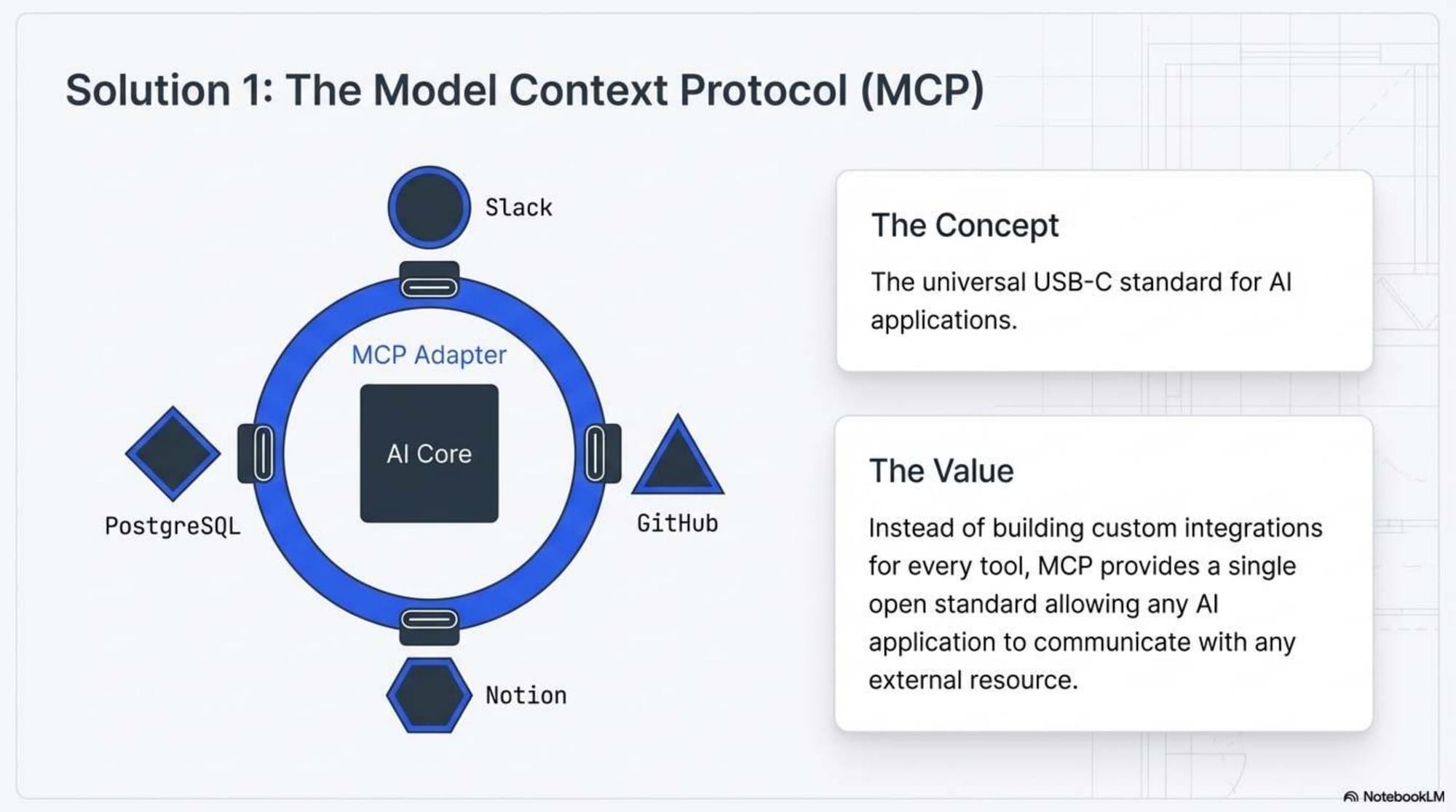
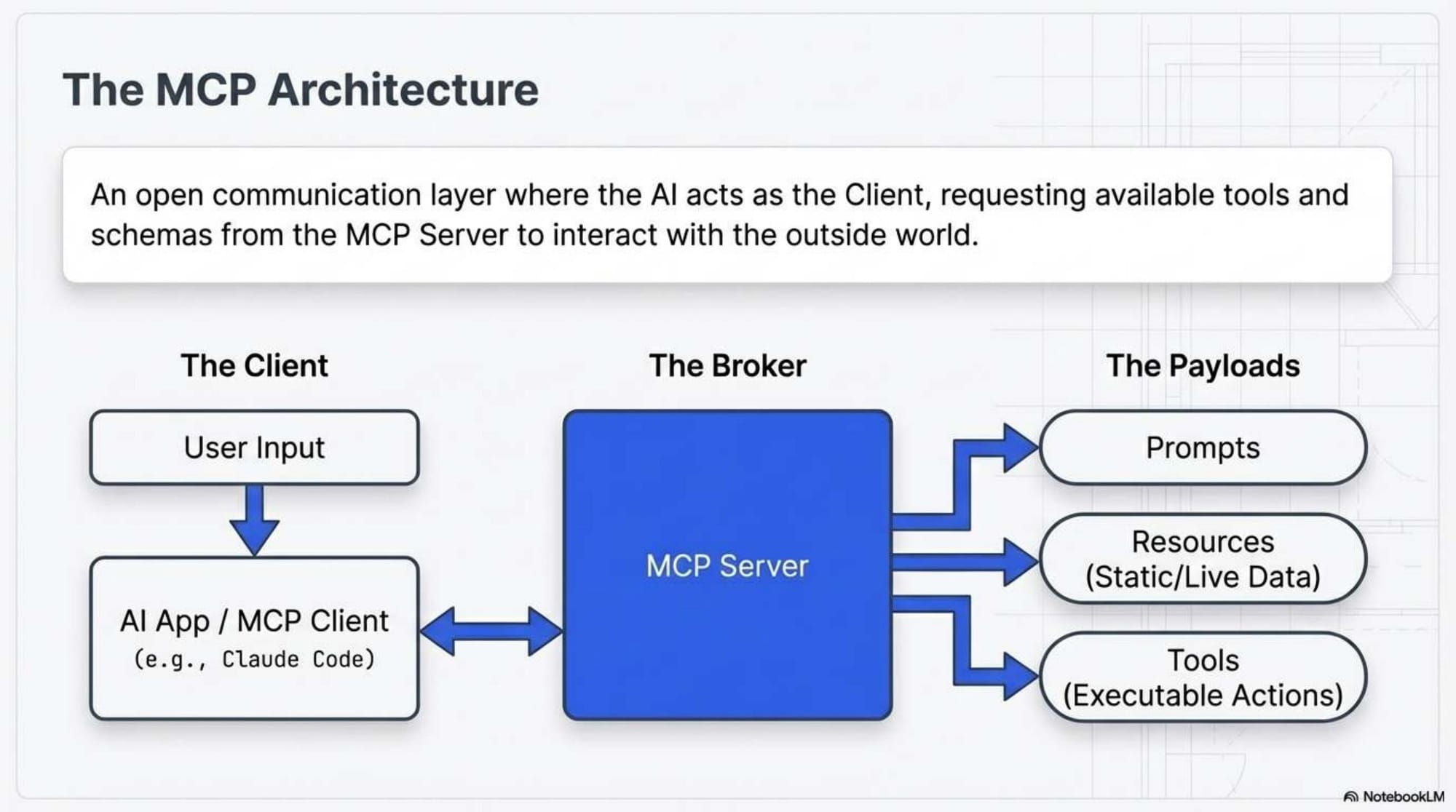
Anthropic likens MCP to the "USB-C port of AI applications". It is an open standard and pluggable infrastructure that provides a universal way for AI apps (like Claude, ChatGPT, or Cursor) to communicate with external tools like Notion, Slack, or GitHub. Instead of every app manually building integrations for every tool, MCP serves as the standardized communication layer.
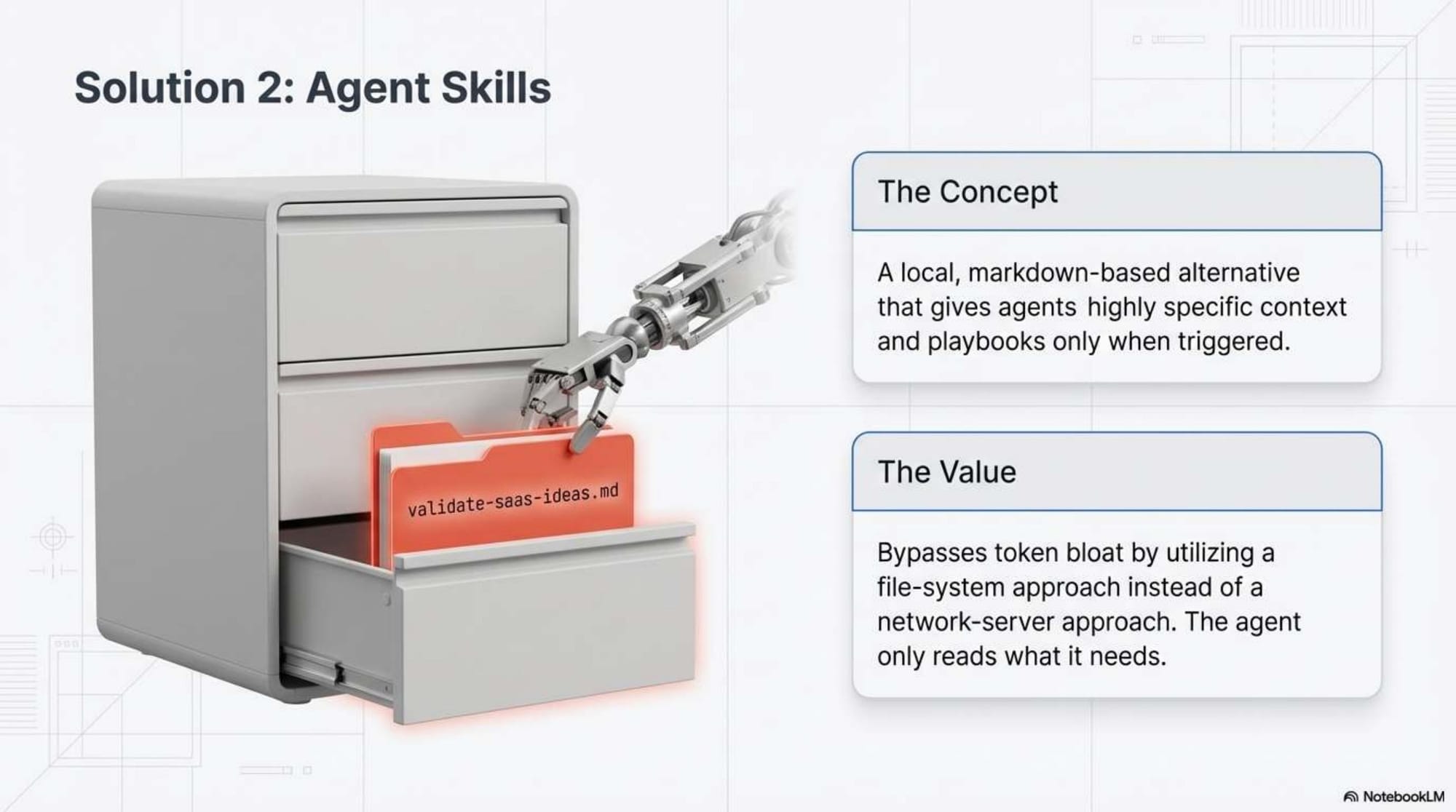
Agent Skills, on the other hand, are fundamentally markdown files (typically named skill.md) that live in a directory your agent can see. They act as extended prompts containing specialized procedures, conditions, and advice for completing a specific task, like validating SaaS ideas or landscaping a house. They don't just grant capabilities; they tell the agent how to apply them.
2. Context Management: "Context Rot" vs. Progressive Disclosure
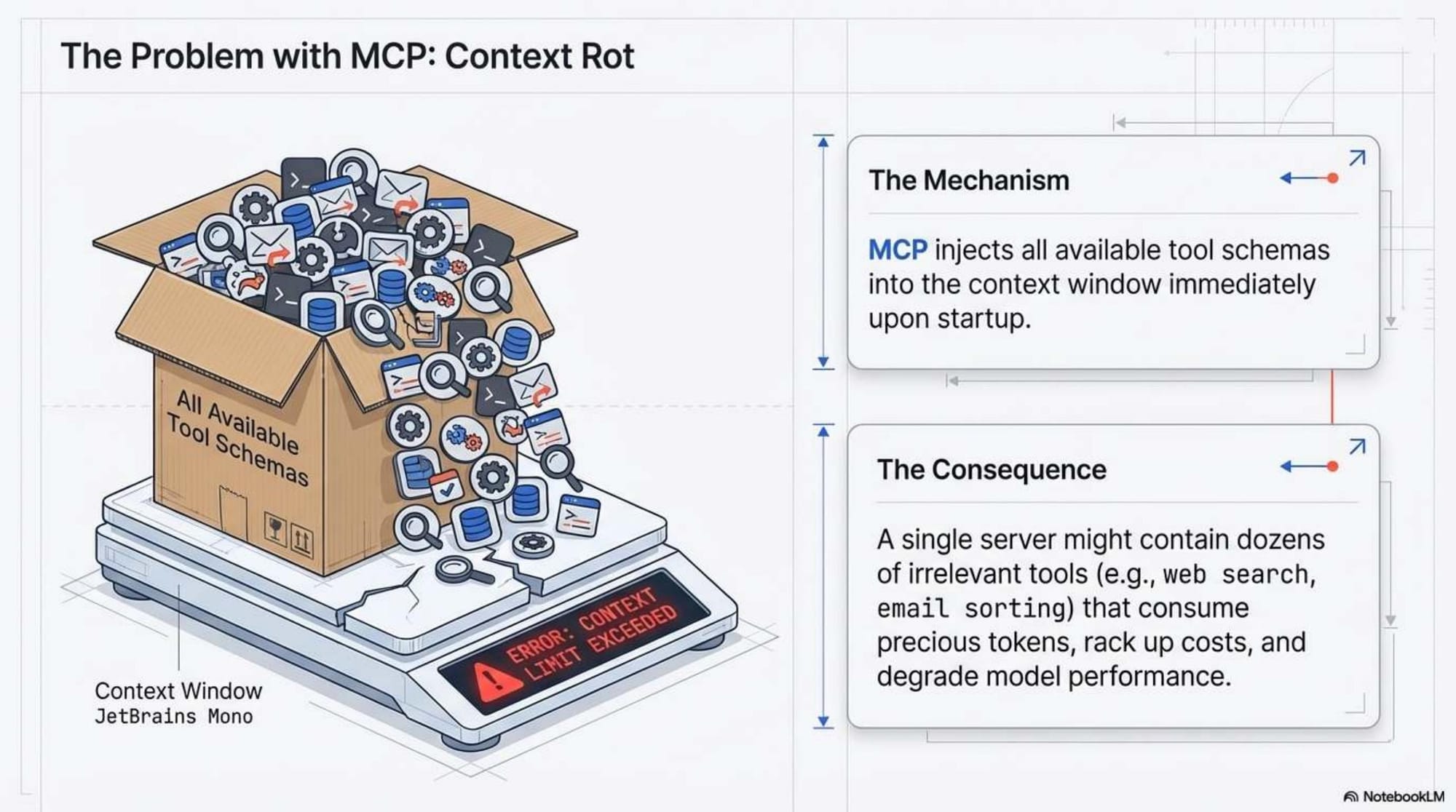
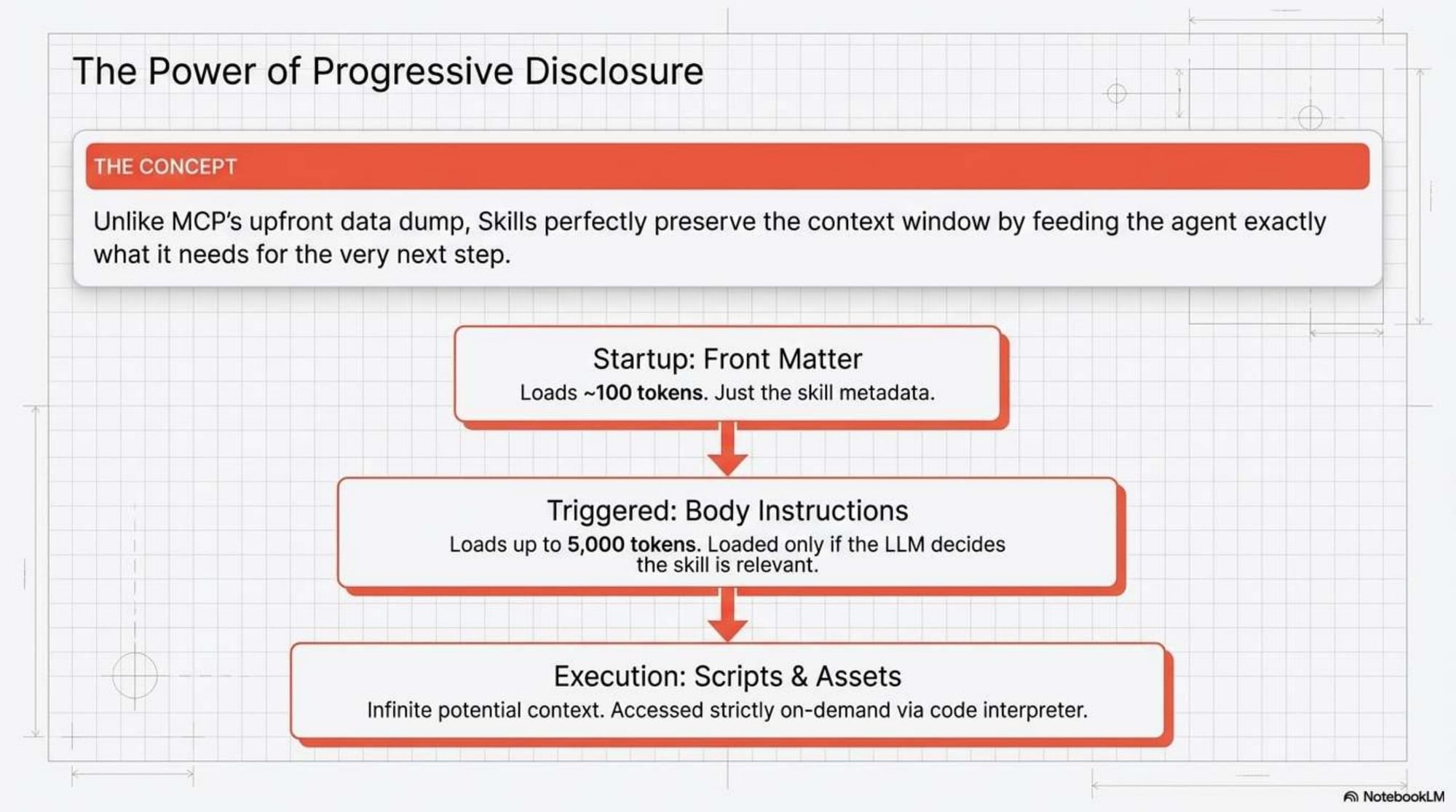
A major challenge with MCP is that it relies on a token-heavy communication style. When an MCP server initializes, it injects all of its available tool schemas into the AI's context window. If your server has tools for web searching, code interpretation, and sorting emails, all of that context is loaded up front—even if your user just wants to read a single file. This wastes precious tokens, racks up costs, and can degrade model performance through a phenomenon known as "context rot".
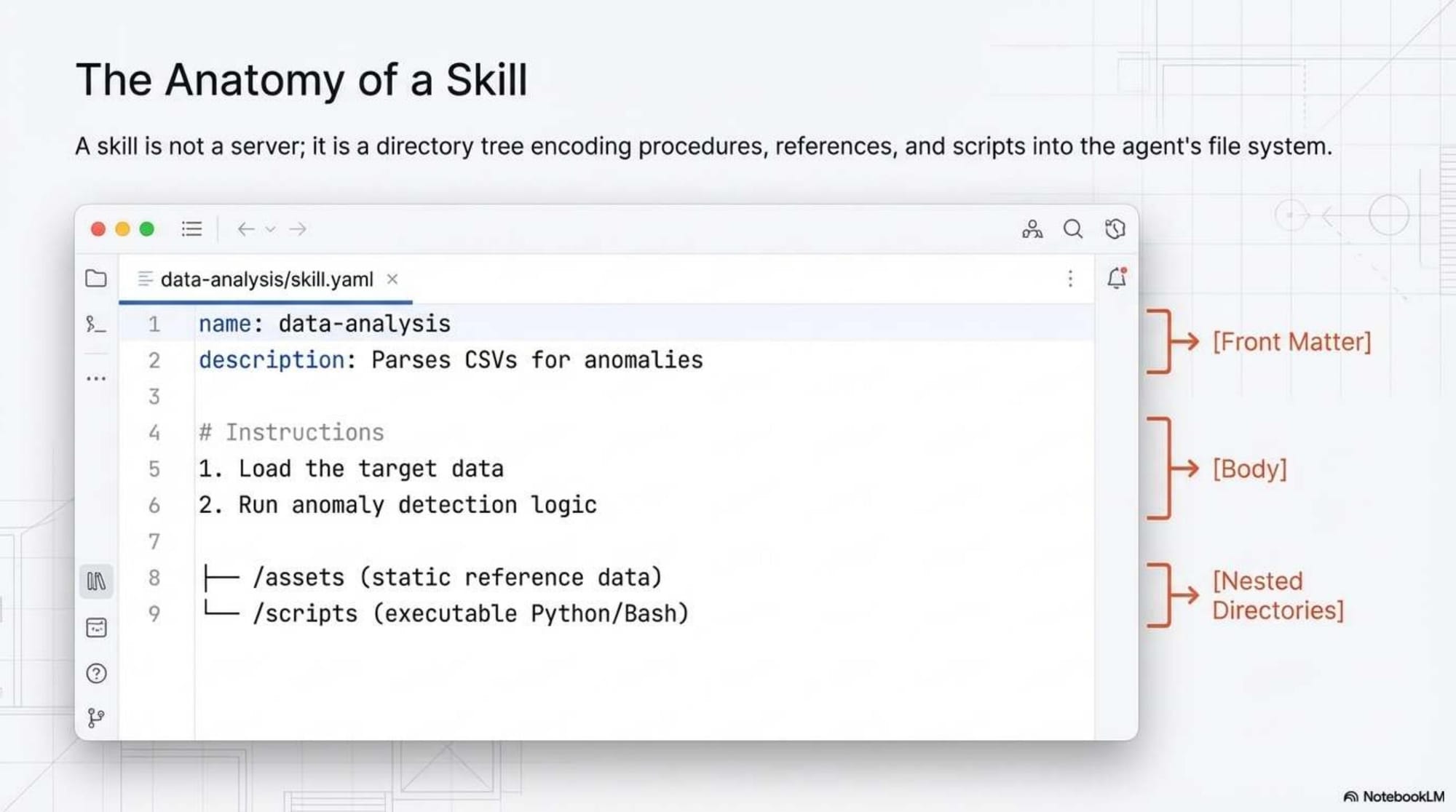
Skills neatly solve this problem using a technique called progressive disclosure. A skill's markdown file is divided into metadata (front matter) and a body. At startup, only the front matter—about 100 tokens summarizing the available skills—enters the context window. Only if the agent determines a specific skill is relevant to the user's prompt will it load the full instructions (up to 5,000 tokens) and any associated executable scripts into its context.
3. Environment Focus: Cloud Infrastructure vs. Local File Systems
The environments where these two technologies excel are distinctly different.
MCP shines when dealing with real-time data and cloud infrastructure. Resources accessed via MCP are often live, such as incoming customer tickets or streams from a Kafka topic. Furthermore, MCP handles complex network authentication—like OAuth 2.1—making it ideal for deploying resources into the cloud or securely opening GitHub issues.
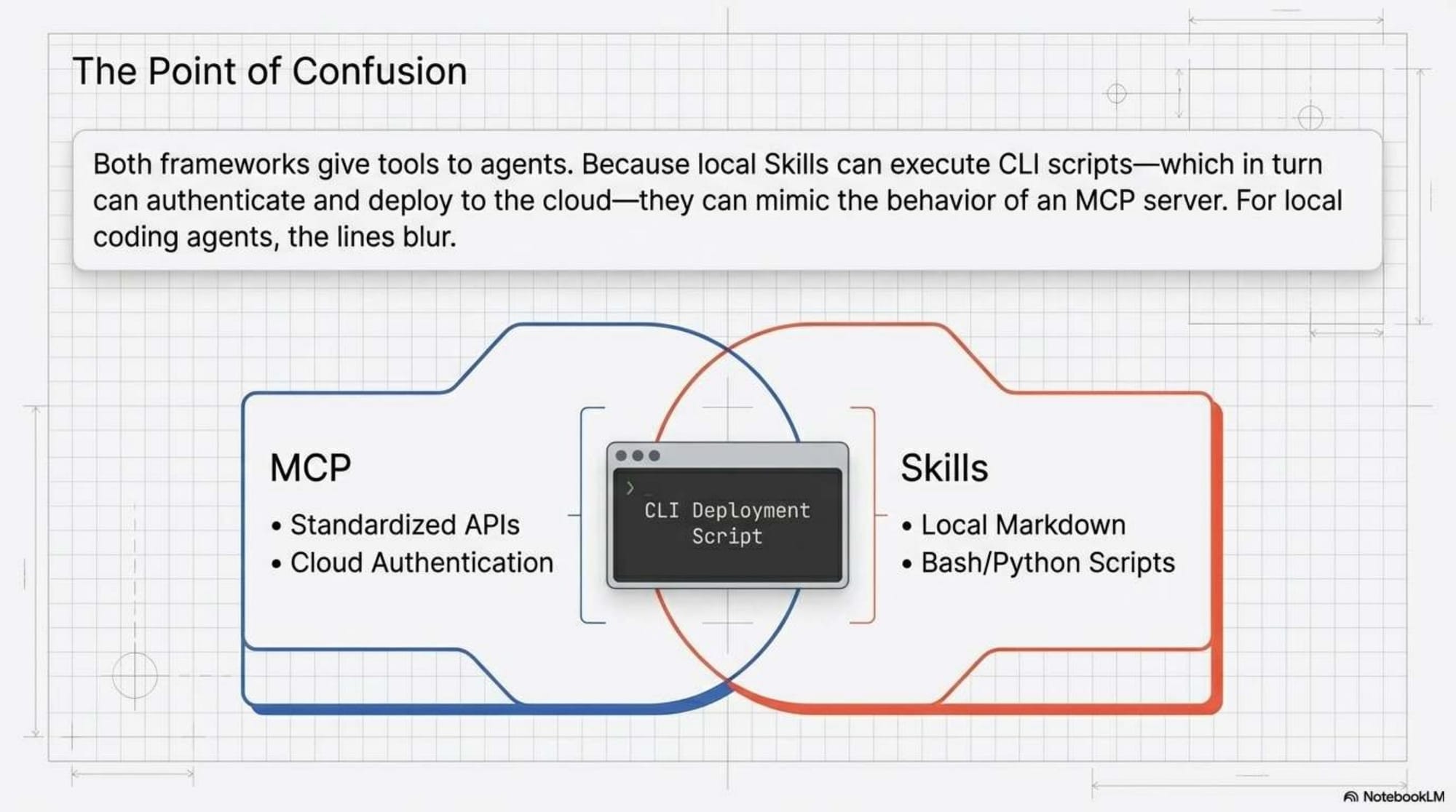
Skills are highly focused on the local file system, making them incredibly powerful for local coding agents like Claude Code running directly on a developer's laptop. Skills often rely on static reference data (like 3D models or climate information for a landscaping skill) and can bundle executable bash or Python scripts right alongside the markdown instructions.
If you are writing a headless, agentic microservice running in the cloud, you will almost certainly need the standardized interface of MCP.
4. Ease of Creation: Writing Code vs. Plain English
Another practical difference is the barrier to entry for developers creating custom workflows.
To build a custom MCP server, you are required to write actual code. You must implement the API to call the tools, handle the networking, and format the schemas.
Creating a custom Skill is significantly easier because it only requires writing plain English. Because skills are just text files in a directory, you avoid the boilerplate and scaffolding of building a server. You simply write your instructions in markdown, organize your folders with necessary scripts or assets, and the agent will know how to access them out of the box.
5. They Are Complementary, Not Mutually Exclusive
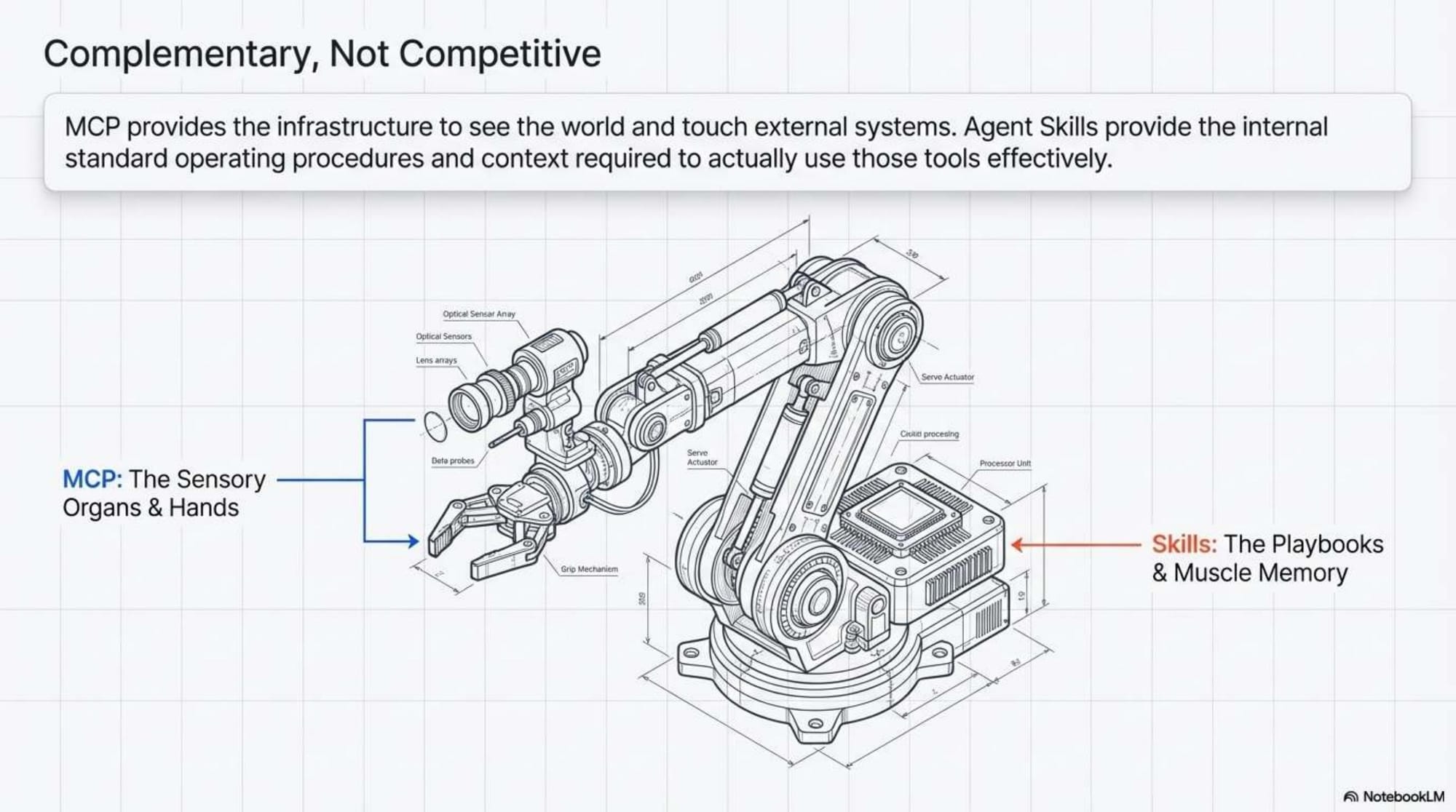
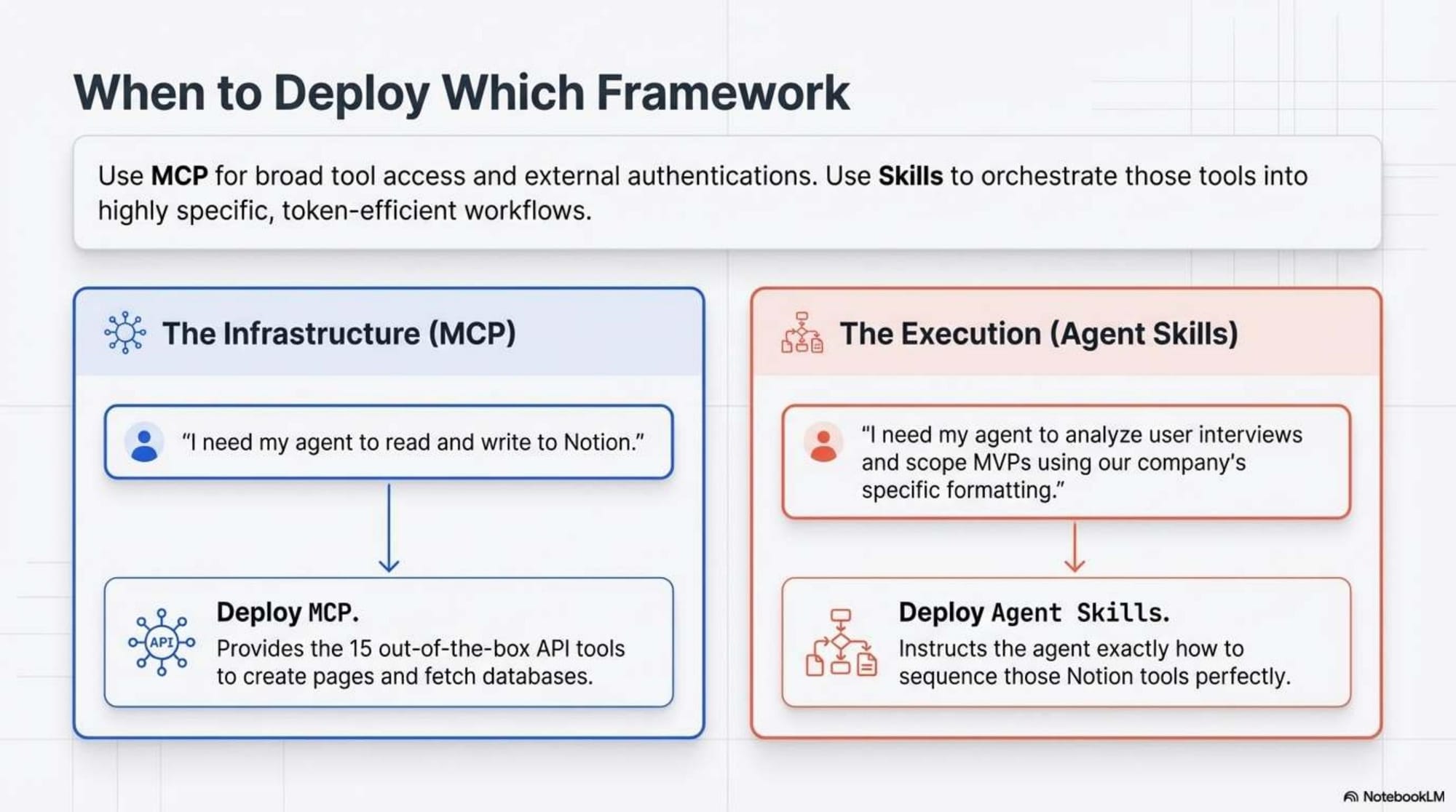
Do skills replace MCP? Ultimately, no. The reality is that the most powerful AI workflows will use them together.
Consider a scenario where you want your AI agent to research an MVP (Minimum Viable Product) idea and generate a detailed spec sheet.
- You would use Notion's MCP server to give the agent the mechanical ability to connect to Notion and create a page.
- You would then use an Agent Skill to instruct the agent on the specific workflow: dictating that the spec sheet must include a customer avatar, a list of pain points, and existing market solutions, and that the agent should perform a web search to fill in the content.
The MCP provides the tools; the Skill provides the expertise.
Conclusion
As AI models continue to advance, bridging the gap between raw intelligence and real-world execution is more important than ever. While it's tempting to view the Model Context Protocol (MCP) and Agent Skills as competing standards, they solve fundamentally different problems. MCP acts as the vital infrastructure connecting agents to live cloud data and external applications, while Skills provide elegant, token-efficient ways to encode complex, step-by-step instructions and local workflows. In this rapidly evolving landscape of software engineering, mastering both will be essential for building truly capable and autonomous AI agents.
📄 Briefing Doc: Technical Analysis
📄 View Full Technical Briefing Document
Executive Summary
As Large Language Models (LLMs) continue to achieve near-perfect performance on reasoning and coding benchmarks, the primary bottleneck in AI application development has shifted to context and tooling. An AI model is only as effective as the context (e.g., proprietary codebase, documentation) and the executable tools it is provided.
Two primary frameworks have emerged to solve this: the Model Context Protocol (MCP) and Agent Skills. While initially perceived by some as competing standards, these frameworks serve distinct but complementary architectural purposes.
Technical Architecture
MCP: Released in November 2024 as an open standard, MCP functions as the "USB-C port of AI applications". It is a pluggable infrastructure providing a standardized communication interface between AI agents and external tools. MCP relies on a client-server architecture where the MCP client lives inside the AI application and communicates with external MCP servers.
Agent Skills: Skills are an open standard representing a file-based approach to providing specialized instructions and executable code to local agents. A Skill is a structured local directory containing a markdown file (skill.md) and optional subdirectories.
Key Implementation Differences
- Context Management: MCP loads all tool schemas upfront (token-heavy), while Skills use progressive disclosure (load only when needed)
- Environment: MCP excels at cloud-based real-time data; Skills excel at local file system workflows
- Creation: MCP requires backend code; Skills require only markdown
- Authentication: MCP supports OAuth 2.1 for cloud services; Skills can use existing CLI auth tokens locally
Synergies: When to Use Both
The most robust architectural implementations utilize both frameworks. MCP gives an agent mechanical tool access, while Skills give the agent operational instructions.
For example, in a Notion MVP spec workflow: MCP provides the API connection to Notion, while a Skill provides the workflow instructions for what content to include and how to structure it.
🔗 References
Primary Sources
- Confluent Developer — Agent Skills or MCP in the era of Claude Code?
- Shaw Talebi — Agent Skills vs MCP: What's the difference?
This analysis was synthesized from technical documentation, developer interviews, and architectural comparisons of both frameworks.
