


TL;DR: The era of 'just using ChatGPT' is ending. Companies like Ramp are now firing developers who can't vibe code, while those who adapt are becoming 10x more valuable. This isn't hype—it's the new baseline for software engineering. Here's what changed, why it happened faster than anyone predicted, and the specific skills that separate future-proof engineers from those being automated away.
🎙️ Podcast: Vibe Coding is the New Survival Standard
📺 Video: Vibe Coding The New Mandate
📑 Slides: The Vibe Coding Mandate
The era of viewing AI as a "nice-to-have" productivity hack is dead. In its place is a harsher, high-velocity reality: you are either AI-native, or you are a legacy asset. This isn't a gradual transition; it is a liquidation of old-school workflows, and it is currently being codified into the performance standards of Silicon Valley's elite.
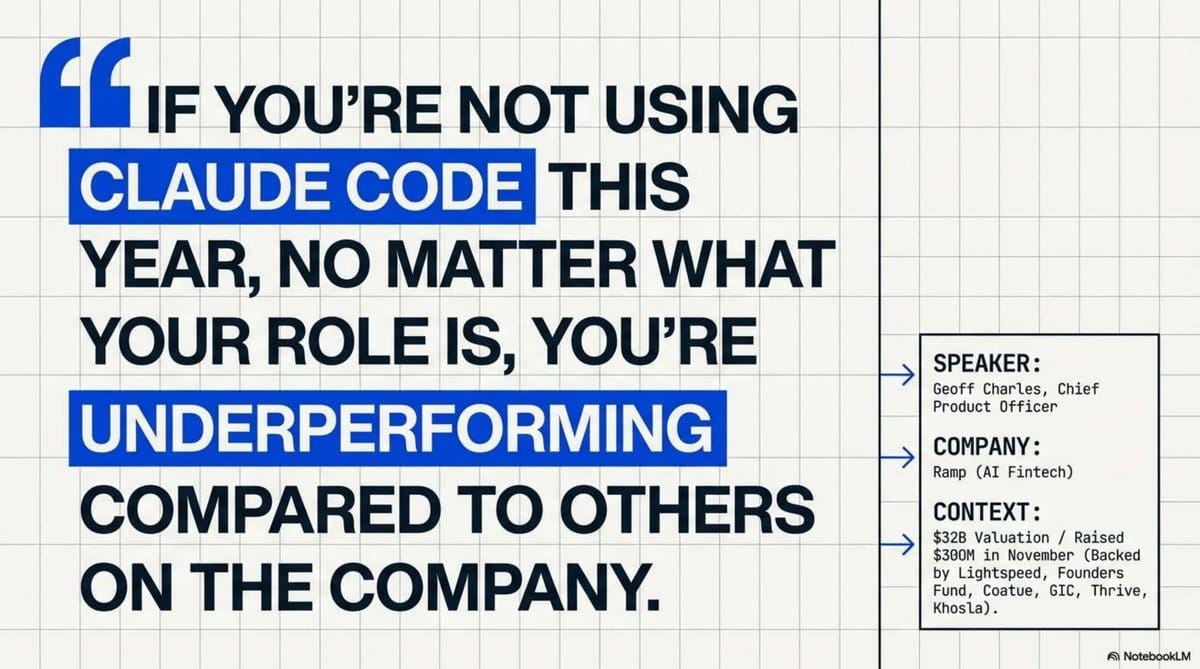
Take Ramp, the $32 billion fintech unicorn. Their leadership has moved past the "experimental" phase of AI adoption and into an era of aggressive mandates. According to Geoff Charles, Ramp's Chief Product Officer, the baseline for professional competence has shifted so violently that traditional, manual output is now viewed as a liability to the company's survival.
The Claude Code Ultimatum
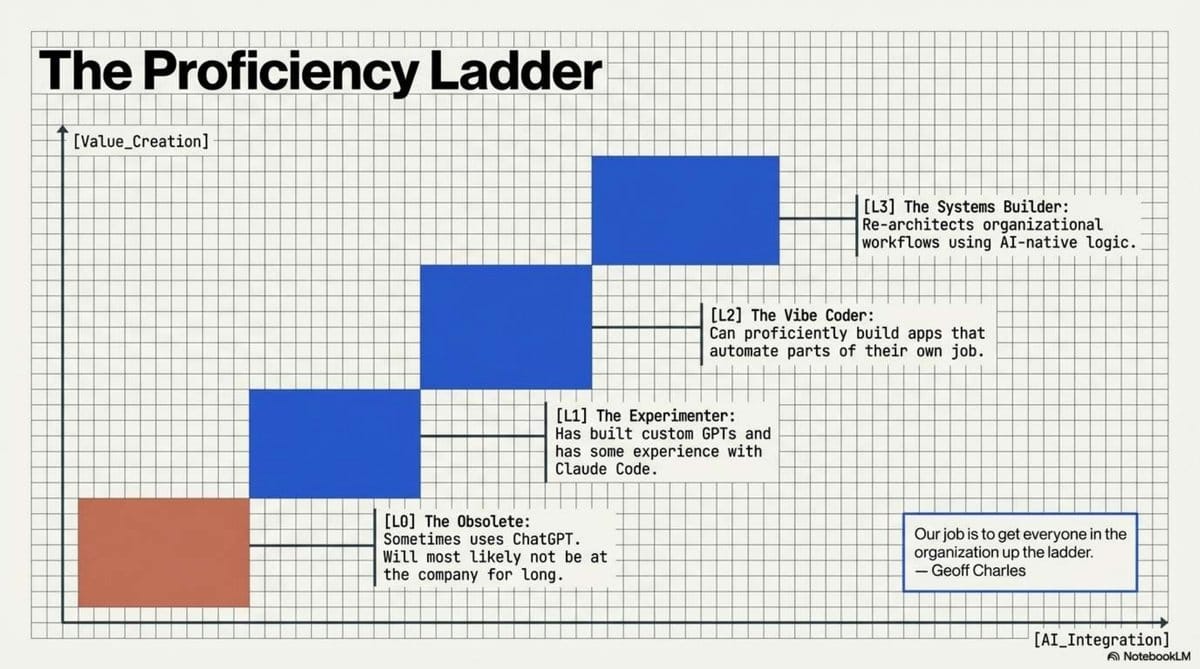
At Ramp, AI proficiency is no longer a personal preference—it is a metric for retention. Charles has established a hierarchy of AI skills that serves as a modern-day sorting hat for the workforce. At the bottom lies "Level 0," a category for staff who merely "sometimes use ChatGPT."
While an occasional prompt might have signaled "tech-savviness" two years ago, it is now categorized as a failure to keep pace. Charles is blunt about the consequences of remaining in this tier:
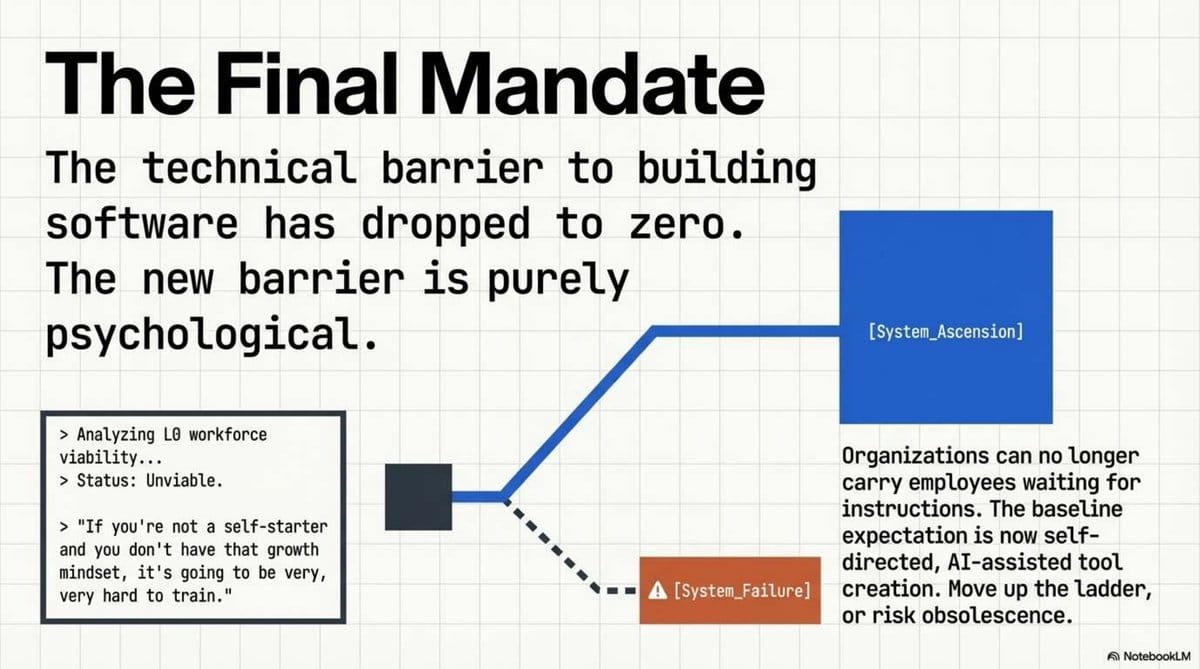
"The people who are still in L0, they will most likely not be at the company."
The new benchmark isn't general AI use; it is specific, high-leverage tool mastery. "If you're not using Claude Code this year, no matter what your role is, you're probably underperforming compared to others on the company," Charles warned. This is the new baseline: specific mastery of agentic tools like Claude Code is now the minimum entry requirement for modern professional relevance.
Vibe Coding and the Death of the 'Non-Technical' Professional
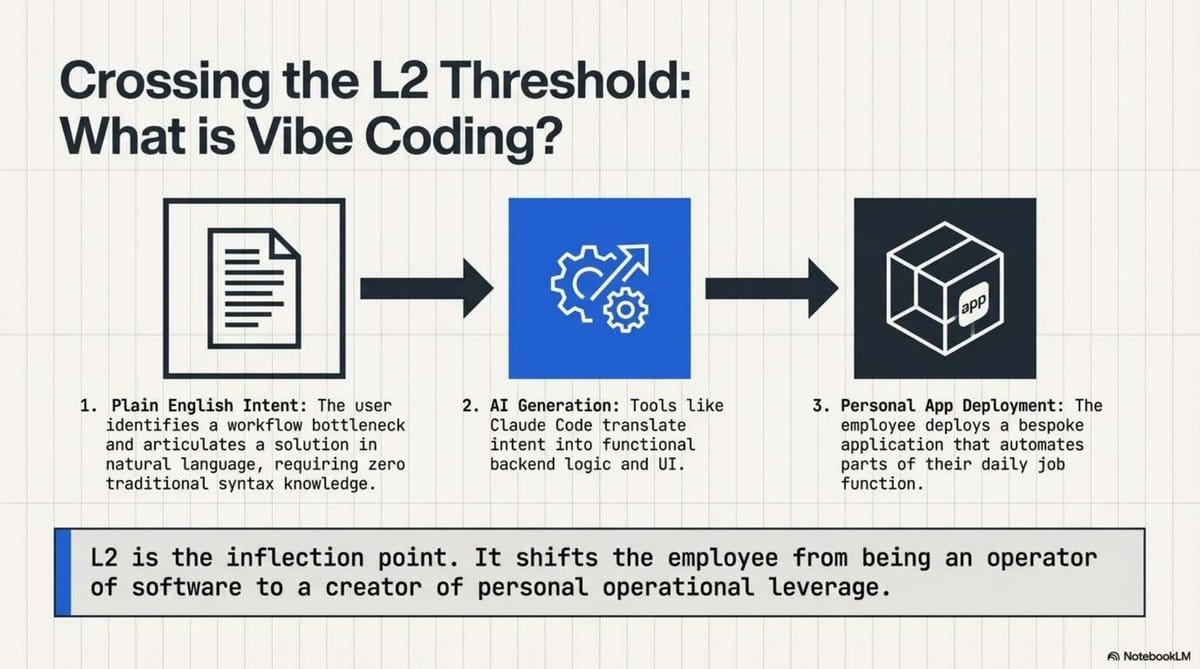
The gold standard for the modern worker is a phenomenon known as "vibe coding." While the term sounds casual, it represents the complete democratization of engineering—and the end of the non-technical professional. Vibe coding describes a level of self-sufficiency where employees use AI-assisted coding tools to build their own software solutions, bypassing the need for a dedicated developer for every minor internal tool or automation.
The Ramp hierarchy defines the progression toward this total self-reliance:
- Level 1: Employees who have moved beyond basic chat to build custom GPTs and possess foundational experience with Claude Code.
- Level 2 (The Vibe Coders): Professionals who can proficiently build apps to automate significant portions of their own jobs.
- Level 3 (Systems Builders): The elite who architect the broader AI-integrated frameworks that power the entire organization.
The jump from Level 1 to Level 2 is the most critical: it marks the point where an employee stops being a "user" and starts being a "builder." In this environment, waiting for the IT department to build a tool for you is no longer a valid workflow—it's a sign of a stagnant mindset.
The 80% Threshold: Why the 'Coordinator' PM is Obsolete
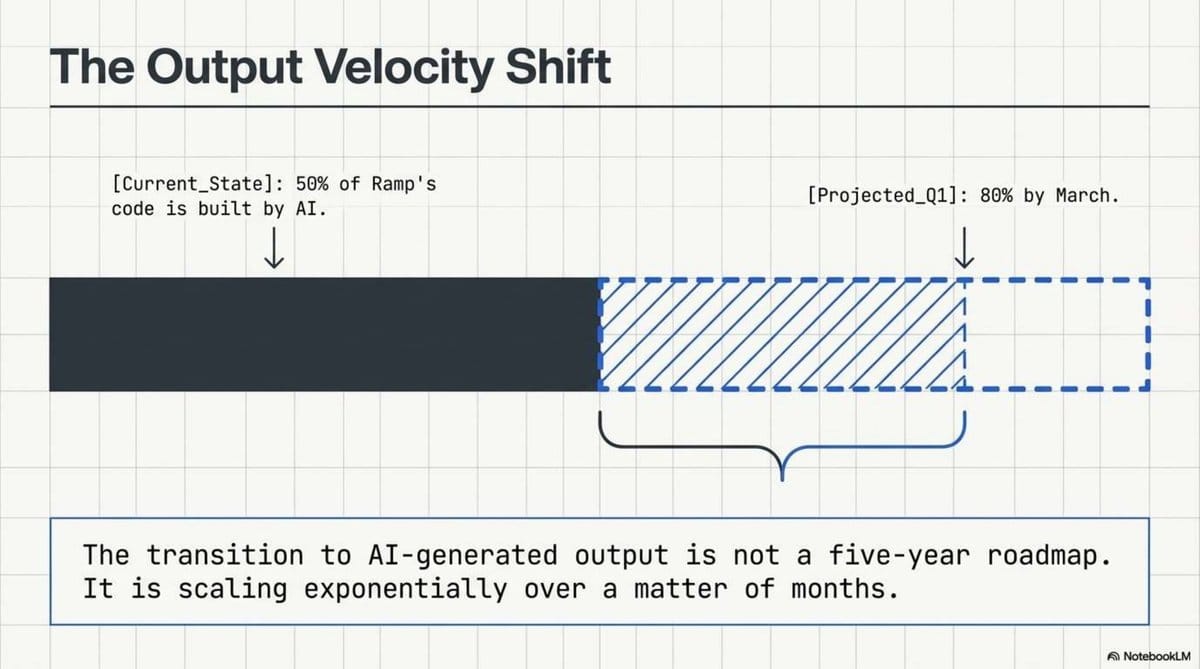
The speed of this shift is reflected in Ramp's production data. Charles revealed that 50% of the company's code is already built by AI today, with a target of 80% by March. This volume of automated output is forcing a fundamental restructuring of the workforce, starting with the Product Manager (PM).
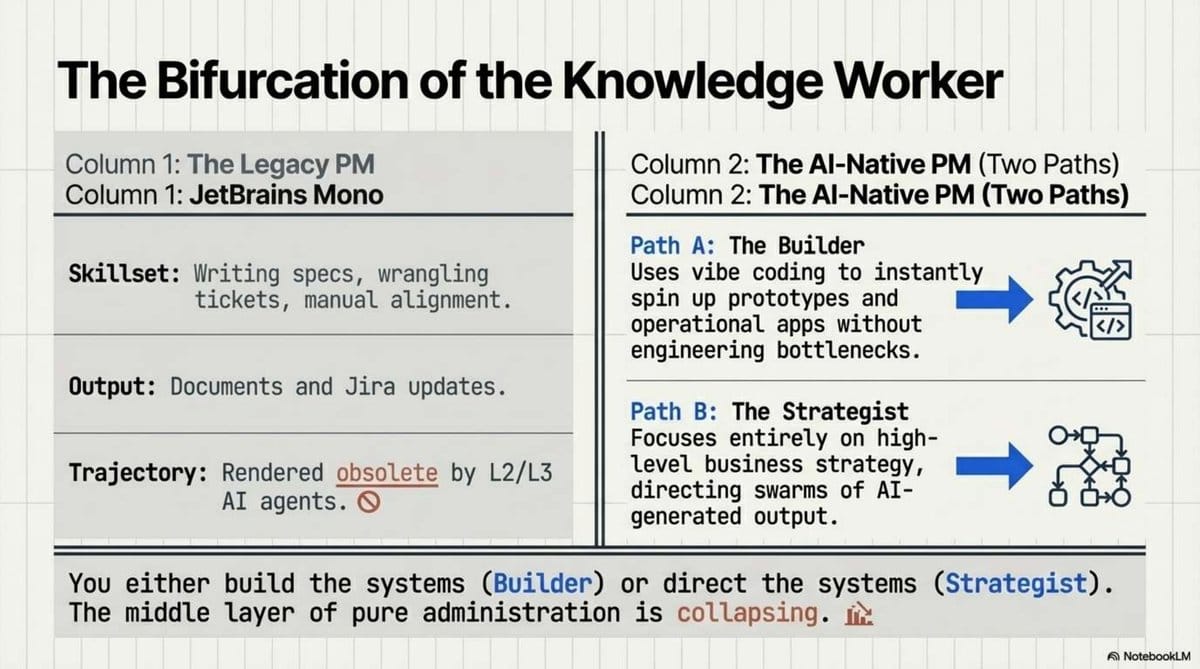
The traditional PM—the middle-man coordinator who manages roadmaps and translates between business and engineering—is becoming obsolete. The role is fracturing into two distinct, high-impact paths:
- The Builder: The PM who uses AI to function as a "Lead Architect," directly executing product creation.
- The Strategist: The PM who functions as a "Business Economist," focusing exclusively on high-level logic and market direction.
As AI handles the bulk of the production, the "middle"—the pure coordinator—has no value left to add.
AI Proficiency as a Corporate KPI
Ramp is not an isolated case. Across the industry, AI adoption is transitioning from a personal hack to a formal corporate Key Performance Indicator (KPI).
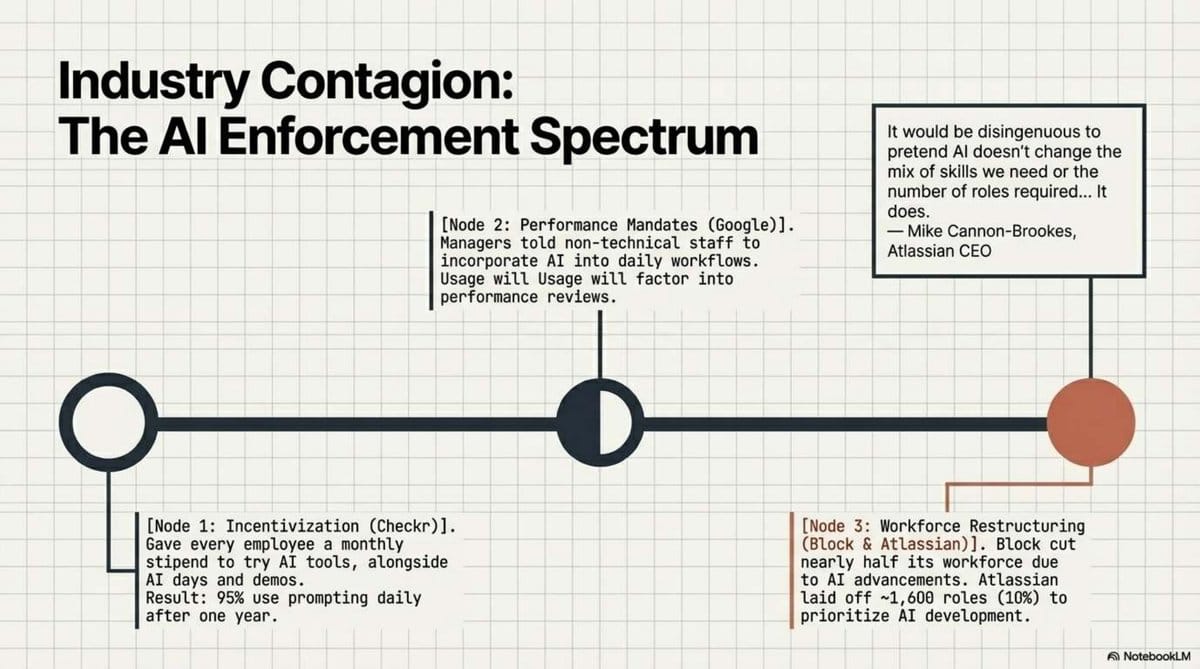
- Google: Managers have informed non-technical staff that AI incorporation is an expected part of daily workflows and will factor directly into performance reviews later this year.
- Checkr: The background-check startup used monthly stipends and "AI days" to force a cultural pivot. The result? After one year of sustained pressure, 95% of employees now use prompting daily across all departments.
The common thread is that "voluntary" adoption is being replaced by mandated integration. The clock is ticking for those who haven't yet integrated these tools into their core identity as workers.
The Layoff Link: AI as the New Workforce Architect
There is a direct, calculated link between aggressive AI adoption and the recent wave of industry layoffs. Companies are reorganization to prioritize those who can operate in an AI-native environment while shedding those with redundant skill sets.
Block recently cut nearly half of its workforce, citing AI advancements as a primary driver for the reduction. Similarly, Atlassian cut 1,600 roles—roughly 10% of its global staff—to prioritize AI development.
Atlassian CEO Mike Cannon-Brookes was transparent about this "mix of skills" shift:
"It would be disingenuous to pretend AI doesn't change the mix of skills we need or the number of roles required in certain areas. It does."
The Growth Mindset or the Exit Door
The ultimate takeaway for the modern professional is that AI proficiency is now the primary metric for a "growth mindset." In an era where the barrier to entry for creation has vanished, those who fail to adopt these tools aren't just "behind"—they are essentially untrainable. As Geoff Charles notes, if you aren't a self-starter in this arena, no amount of corporate upskilling can save you.
The era of "sometimes using ChatGPT" is over. You are either building the systems that automate your role, or you are waiting for those systems to replace you. The question is no longer if you will use AI, but whether you can vibe code well enough to survive the next performance review.
🔗 References
- Research analysis synthesized from industry reports and corporate announcements
