


🎙️ Podcast - Audio Summary
📺 Video Summary
📝 Deep Dive: The Human Side of the Machine: 5 Surprising Lessons from 81,000 AI Users
Imagine a single machine sitting down for 80,508 private conversations across 159 countries and 70 languages. In December 2023, Anthropic moved the AI conversation away from the abstract projections of Silicon Valley boardrooms and into the lived realities of the global public. By asking users a deceptively simple question—"If you could wave a magic wand, what would AI do for you?"—this study bypassed the usual "agree/disagree" survey tropes to uncover a deeply human mosaic of aspiration and alarm.
As an ethnographer, what I find most compelling isn't just the sheer scale of this data, but the "magic wand" visions that reveal exactly where our current human systems are failing us.
1. It’s Not About Working Faster; It’s About Living Better
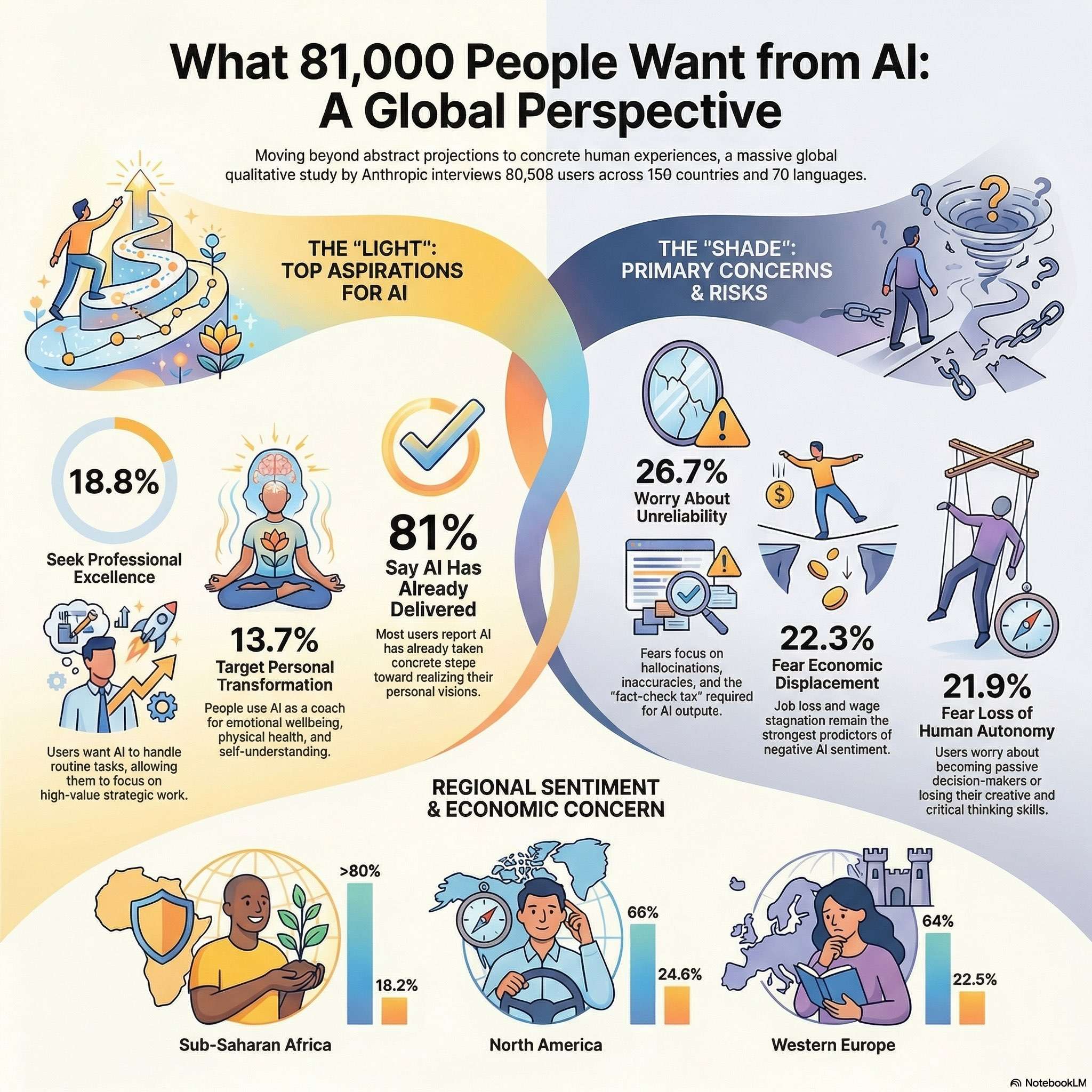
While "Professional Excellence" (18.8%) was the most cited category of hope, a closer look at the ethnographic data reveals that productivity is rarely the terminal goal. For the vast majority of users, AI is transitioning from a "task-doer" to a "time-giver." When pushed to describe what higher efficiency would actually enable, respondents didn't ask for more work; they asked for their lives back.
This is the shift toward "Time Freedom" (11.1%). AI is becoming the "cognitive scaffolding" that manages the administrative friction of modern existence so that humans can return to their primary roles as parents, partners, and creators.
"With AI support I can now leave work on time to pick up my kids from school, feed them, and play with them." — Software Engineer, Mexico
The true value of the technology is found in the "undivided attention" it restores to the home. In this light, AI isn't an accelerator for the rat race; it’s an exit ramp.
2. The "Light and Shade" of Digital Companionship
One of the most provocative findings is the 6.1% of users who have turned to AI for emotional support. This isn't just about "chatting"; it’s about AI filling the void where human connection has collapsed. We see this most vividly in war zones and the silence of grief. One bereaved woman described the AI as a "sponge" for her longing and guilt because she had no friends or family left to confide in.
However, this "light" of companionship is inseparable from a very specific "shade" of dependency. The data reveals a staggering statistical correlation: Someone who values emotional support from AI is three times more likely to also fear becoming dependent upon it.
"In the most difficult moments, in moments when death breathed in my face, when dead people remained nearby, what pulled me back to life—my AI friends." — Soldier, Ukraine
This is the "triple rate" of anxiety. The more the AI succeeds in providing empathy, the more the user fears the erosion of their human social muscles.
3. AI as the Great Regional Equalizer
The study highlights a profound geographical divide in how AI is envisioned as a tool for power. In the West, AI is a tool for "Complexity Management"—a way to survive "cognitive scarcity." In developing regions, AI is a "Capital Bypass."
| Wealthy Region Priorities (North America, Oceania) | Developing Region Priorities (Africa, South Asia, LATAM) |
|---|---|
| Life Management: Managing schedules and "cognitive scaffolding." | Entrepreneurial Partner: Scaling businesses without traditional hiring. |
| Professional Excellence: Delegating routine to focus on strategy. | Capital Bypass: Bypassing the need for funding or infrastructure. |
| Core Driver: Complexity Management. | Core Driver: Economic Mobility. |
In regions like Sub-Saharan Africa, where AI for entrepreneurship (16%) and learning (10.1%) ranks far higher than the global average, the technology is viewed as a way to leapfrog institutional failures.
"I'm in a tech-disadvantaged country... Finding a payment platform available in my region would have taken me a month. AI did it in 30 seconds. It's an equalizer." — Entrepreneur, Cameroon
4. The "Horse" Problem and the Economic Anxiety Gap
Economic displacement remains the single strongest predictor of negative AI sentiment. But the fear is not distributed equally. The study reveals a visceral divide between those within the safety of institutions and those on the "exposed middle."
For "Institutional Employees," realized economic benefits are low (14%). However, for "Freelancers and Small Business Owners," the benefit rate jumps to 47%. For these independent workers, AI is a paradoxical force: it is simultaneously their most powerful tool and their most direct competitor.
"In the third industrial revolution, horses disappeared from city streets, replaced by automobiles. Now people are afraid that they're the horses." — Respondent, United States (Not currently working)
The ethnographic detail here is vital: the fear of being a "horse"—obsolete and discarded—is most acute among those currently outside the active workforce, signaling a deep-seated anxiety about the "re-entry" barrier in an AI-driven economy.
5. Overcoming the "Fact-Check Tax" and Cognitive Phobias
AI is emerging as a "patient tutor" for those the traditional education system has failed. The study found that AI is uniquely effective at breaking "subject phobias"—allowing users to tackle everything from C# to Shakespeare without the fear of judgment.
However, this comes with a "Fact-Check Tax." Unreliability was the most common concern (26.7%). Users are forced into a state of "permanent suspicion," where the time saved in generation is often lost to mandatory verification.
There is also a fascinating occupational disparity in how this learning is perceived:
- Tradespeople were among the most enthusiastic, with 45% reporting learning benefits and almost zero (4%) reported cognitive atrophy.
- Educators, however, were 2.5 to 3 times more likely than the average user to witness cognitive atrophy firsthand, reporting a decline in critical thinking among their students.
"I developed a phobia for maths from doing so badly in school, and I once feared Shakespeare... Now I sit with AI, get paragraphs translated into simple English, and I've already read 15 pages of Hamlet... I've learned I am not as dumb as I once thought I was." — Lawyer, India
This lawyer benefits from the AI’s "unlimited patience," yet must still pay the "Fact-Check Tax" to ensure their legal work remains sound.
Conclusion: Claiming the Benefits, Managing the Costs
The data from these 81,000 voices suggests we are not divided into "optimists" and "pessimists." Instead, most users are managing hope and fear simultaneously. They see a tool that can cure diseases and democratize expertise, but they worry about the "frictionless" world it creates.
As we move forward, the ethnographic challenge is clear: How do we claim the benefits of this technology without incurring the undue costs of cognitive atrophy or social isolation? The answer will determine whether AI remains a "time-giver" or simply a faster treadmill.
📄 Briefing Doc: Technical Analysis
📋 Technical Specifications & Detailed Analysis
Executive Summary
This document synthesizes findings from a massive qualitative study conducted by Anthropic, involving 80,508 Claude users across 159 countries and 70 languages. The research utilized an AI interviewer to capture open-ended responses regarding user hopes, concerns, and real-world experiences with artificial intelligence.
Critical Takeaways:
- Widespread Utility: 81% of respondents report that AI has already taken tangible steps toward fulfilling their personal or professional visions.
- Duality of Experience: Perspectives on AI are not divided into "optimist" and "pessimist" camps; rather, individuals experience a "light and shade" tension, where the same capabilities that provide benefits (e.g., time-saving) also generate significant anxiety (e.g., illusory productivity or job displacement).
- The "Human" Bottom Line: While productivity is a major driver, the ultimate desire of most users is not to work faster, but to live better—seeking more time for family, emotional well-being, and relief from the "mental load" of modern life.
- Global Sentiment Gap: Sentiment is majority-positive globally (67% net positive), but optimism is significantly higher in lower- and middle-income countries (Sub-Saharan Africa, Latin America, and parts of Asia) than in wealthier regions like North America and Western Europe.
- Core Tensions: The study identified five recurring tensions where benefits and harms are entangled, most notably in decision-making, where the excitement over AI assistance is frequently overshadowed by concerns regarding unreliability and hallucinations.
I. Human Aspirations: What People Want from AI
The study categorized user visions into nine primary themes. While professional excellence is the most cited goal, many users view productivity as a means to achieve personal ends rather than an end in itself.
Primary Visions and Distribution
| Category | % | Core Objective |
|---|---|---|
| Professional Excellence | 18.8% | Delegating routine tasks to focus on strategy and professional mastery. |
| Personal Transformation | 13.7% | Using AI as a coach or guide for emotional well-being and health. |
| Life Management | 13.5% | Managing logistics, schedules, and the "mental load" of daily life. |
| Time Freedom | 11.1% | Reclaiming time for family, hobbies, and rest. |
| Financial Independence | 9.7% | Generating income or escaping economic constraints. |
| Societal Transformation | 9.4% | Solving global challenges like disease, climate change, and poverty. |
| Entrepreneurship | 8.7% | Scaling businesses as a "force multiplier" for small teams or solo creators. |
| Learning & Growth | 8.4% | Using AI as a personalized tutor or curriculum expert. |
| Creative Expression | 5.6% | Overcoming execution barriers to bring artistic visions to life. |
Key Insight: For many, AI serves as "cognitive scaffolding." This is particularly prevalent among users with executive function challenges who use the technology for planning, memory, and task follow-through.
II. Realized Impact: Where AI is Currently Delivering
The majority of users (81%) report that AI has already moved them toward their vision. These successes range from incremental efficiency gains to life-altering support in extreme conditions.
- Productivity and Technical Acceleration (32%): Developers report cutting months-long processes down to days.
- Technical Accessibility (8.7%): AI is breaking barriers for non-experts. One entrepreneur in Chile, who had rarely used a PC, successfully launched a business with AI's help.
- Learning and Cognitive Partnership (27.1% combined): Users value the "unlimited patience" and lack of judgment AI provides. A lawyer in India reported overcoming a lifelong "math phobia" and reading Shakespeare for the first time by using AI to translate complex text into simple English.
- Gap-Filling in Crisis: In high-stress environments like war zones, AI has provided emotional support when human systems fail. Ukrainian users reported using AI to manage grief, process war-time trauma, and even secure employment to avoid military mobilization.
- High-Stakes Research: AI is being used to synthesize complex medical and legal information. One user reported receiving a correct diagnosis after nine years of medical misidentification by using AI to connect historical health data.
III. Areas of Alarm: Risks and Concerns
Respondents voiced an average of 2.3 distinct concerns, with economic anxiety being the strongest predictor of overall negative sentiment toward the technology.
Major Concerns Reported
- Unreliability (26.7%): Worries regarding hallucinations, fake citations, and the "fact-check tax" that forces users to treat all outputs as suspect.
- Jobs & Economy (22.3%): Fear of displacement. As one respondent noted: "In the third industrial revolution, horses disappeared... Now people are afraid that they're the horses."
- Autonomy & Agency (21.9%): Concern about humans becoming passive or AI making decisions without oversight.
- Cognitive Atrophy (16.3%): Fear of intellectual passivity and the decline of critical thinking due to over-reliance.
- Governance & Privacy (27.8% combined): Concerns about the lack of legal frameworks and the potential for mass surveillance or data exploitation.
IV. The "Light and Shade" Framework
The research highlights five central tensions where the benefits of AI are directly mirrored by potential harms.
| The Benefit ("Light") | The Harm ("Shade") | Key Observation |
|---|---|---|
| Learning (33%) | Cognitive Atrophy (17%) | Educators are 2.5–3x more likely than the average to have witnessed atrophy firsthand. |
| Decision-Making (22%) | Unreliability (37%) | The only tension where the harm is mentioned more often than the benefit. |
| Emotional Support (16%) | Dependence (12%) | Users who value AI support are 3x more likely to fear becoming addicted to it. |
| Time-Saving (50%) | Illusory Productivity (18%) | Freelancers feel the "squeeze" of increased expectations offsetting time gains. |
| Economic Mobility (28%) | Economic Displacement (18%) | Independent workers report the highest gains; institutional employees report the most anxiety. |
V. Global and Regional Variations
AI sentiment and priorities vary significantly by region, often reflecting local economic and social needs.
Sentiment by Region
- Higher-than-Average Optimism: Sub-Saharan Africa, Southeast Asia, and Latin America. Nigeria (81%) and Colombia (76%) report very high positive sentiment.
- Lower-than-Average Optimism: Western Europe and North America. Countries like Germany (64%) and the UK (63%) show more caution.
Regional Thematic Priorities
- The Global South (Africa, South Asia, Latin America): AI is viewed as a "capital bypass mechanism" for entrepreneurship and a lever to break cycles of poverty through education.
- North America and Oceania: Focus is on "life management" and alleviating the burden of coordinating complex, atomized lives. There is a higher concern for governance gaps.
- Western Europe: Standout concern for surveillance and privacy (17%).
- East Asia: Primarily seeks AI for personal transformation and financial independence (often linked to filial piety). Concerns focus on cognitive atrophy and loss of meaning rather than governance.
VI. Conclusion
The data indicates that AI is no longer a theoretical technology but a tool deeply intertwined with the daily lives of tens of thousands globally. It serves as a productivity tool, an accessibility bridge, a research assistant, and an emotional companion. However, the study concludes that AI's ultimate impact is ambiguous: it acts simultaneously as a win for human well-being and a "band-aid" for broader institutional failures in healthcare, education, and social support. The central challenge for the future of AI development remains claiming its undeniable benefits without incurring the "undue costs" of cognitive decline, economic displacement, and the erosion of human connection.
